
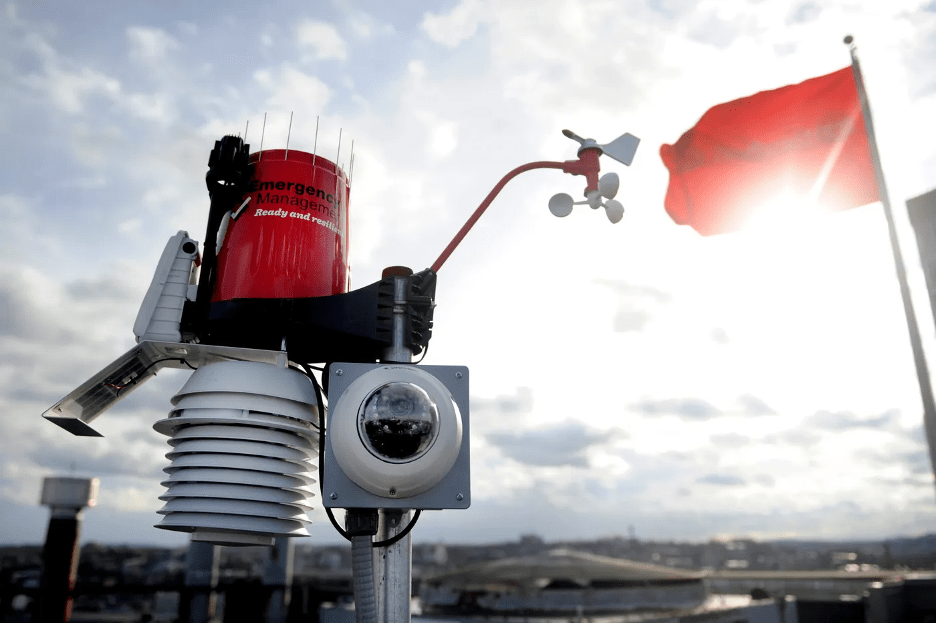
Overview: Northeastern has transformed its campuses into living labs for climate monitoring through the design and installation of weather stations. Supported by an NU Sustainability grant, the project began on the Boston campus with the creation of sensors and a real-time visualization platform, then expanded to Oakland after the merger with Mills College. Together, these efforts show how student and faculty collaboration can generate high-quality climate data to support campus planning, research, and resilience.
How it Works: The interdisciplinary team fabricated and installed sensors that track air quality, temperature, humidity, and wind patterns. In Boston, the team partnered with the arboretum to refine sensor technology and develop a real-time data platform. In Oakland, students in CAMD deployed a network of stations and developed installation protocols to ensure research-grade accuracy. These projects merge environmental science, design, and data visualization, making both campuses hubs for sustainability innovation.
Expected Outcomes:
-
Generate long-term environmental data for teaching, research, and decision-making.
-
Support campus sustainability planning with real-time insights.
-
Build an interdisciplinary learning platform across design, science, and policy.
Campus & Global Impact: Locally, the stations strengthen Northeastern’s ability to respond to challenges such as heat waves and air quality impacts from wildfire smoke. Globally, the project demonstrates how universities can empower students to design and operate monitoring networks that improve resilience and advance environmental justice.
Contacts: Carlos Sandoval Olascoaga
Related Sustainable Development Goals:


CONTACT US
Do you have questions for Sustainability Incubator? Please reach out to us.